A reassuring UK guide to circumcision healing, week by week, for babies and adults. Learn what is normal, the warning signs, and when to call us.
June 24, 2026
November 18, 2026
If you are watching a circumcision heal, whether it is your own or your baby’s, it is natural to wonder what is normal. This guide walks you through circumcision healing step by step, so you know what to expect and when to ask for help. We cover newborns, children and adults, and we explain the warning signs that mean you should contact a clinician.
Healing usually follows a predictable path. Some swelling, bruising and colour change are part of that path, not a sign that something has gone wrong. The aim here is to help you tell the difference between ordinary healing and the small number of signs that need a professional review.
We have written this as a reassurance-first guide because the early days can feel uncertain. By the end, you should have a clear picture of the usual stages, the signs that everything is on track, and the moments when it is sensible to pick up the phone.
For most adults, it takes around 4 to 6 weeks for the penis to heal fully after a circumcision, although it can sometimes take a little longer1. Babies and young children often heal faster, with the area usually looking much better within 7 to 10 days and settling over a few weeks2.
Healing is not one single moment. The surface tends to look better within the first one to two weeks, while deeper healing and the final cosmetic result continue over the following weeks. The table below gives a general guide.
| Age group | Early healing (looks better) | Full healing (typical) |
|---|---|---|
| Newborns and babies | 7 to 10 days | Around 2 to 4 weeks |
| Older children and teens | 7 to 14 days | Around 3 to 6 weeks |
| Adults | 10 to 14 days | Around 4 to 6 weeks |
These are typical ranges, not fixed rules. Your own timeline may be a little shorter or longer, and that can still be perfectly normal. Age, the method used, general health and how closely aftercare is followed can all gently nudge the timeline in one direction or another.
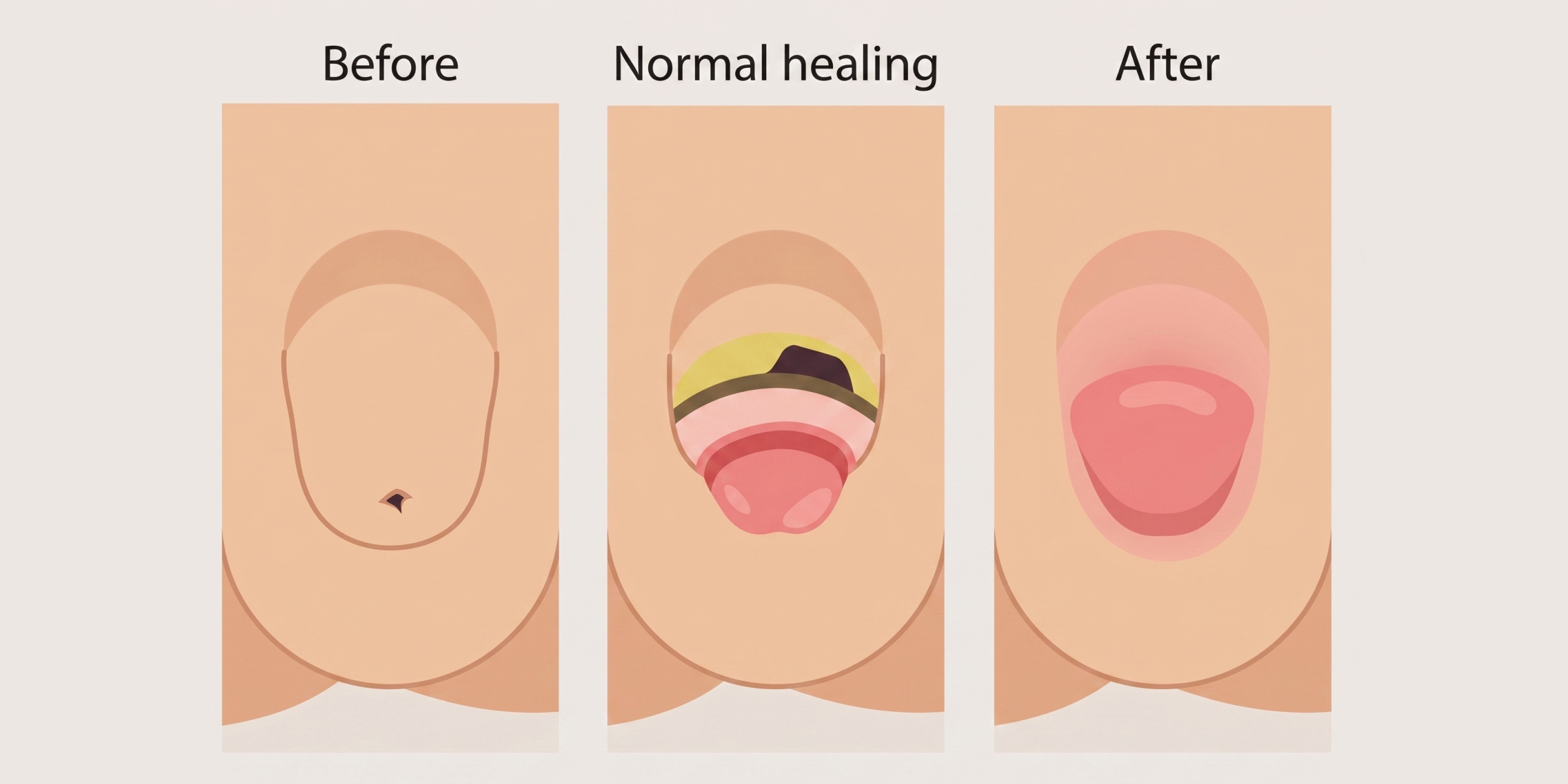
In the first days and weeks, the area often looks worse before it looks better. This is expected. Normal circumcision healing can include swelling, bruising, colour changes, a yellow or white film, and a little oozing. Here is what each of these means.
Swelling and bruising are common for the first 1 to 2 weeks1. The skin may look red, pink, purple or darker, and the head of the penis can appear shiny or swollen. On black or brown skin, redness can be harder to see, so look for warmth and changes in how the area feels as well1.
The tip is often very sensitive at first. This usually eases over the following weeks as healing settles.
A yellow or whitish film often appears over the healing area after a few days. This is granulation tissue, a normal part of wound healing, and it is not the same as pus3. It can look a little alarming, but it usually means the body is doing its job. Do not try to wipe or scrub it away.
Minor bleeding or oozing can happen for the first week or two, especially after a nappy change or when the area is gently moved1. A few small spots of blood are usually nothing to worry about. Heavy bleeding that does not stop is different, and we cover that in the warning signs below.
Knowing the usual circumcision healing stages can take a lot of the worry out of the first few weeks. The pattern below is a general guide for the typical healing process.
| Stage | What you may notice |
|---|---|
| Days 1 to 3 | Swelling, bruising and tenderness are at their peak. Some oozing or spotting can occur. |
| Days 4 to 7 | A yellow or white film often forms. Swelling starts to settle and discomfort eases. |
| Week 2 | Bruising fades. The area looks less raw, though it may still be sensitive. |
| Weeks 3 to 6 | The surface looks much more settled. Deeper healing and the final appearance continue to develop. |
A baby’s circumcision often looks better within 7 to 10 days, with fuller healing over the following weeks2. It is very common for the area to look swollen and to develop a yellowish film in the first few days. This is normal and tends to settle on its own3. You can find step-by-step care advice in our newborn after circumcision guide.
For adults, the male circumcision healing time is usually around 4 to 6 weeks for full healing1. You may feel tightness or discomfort during an erection in the early weeks, which usually eases as the area settles1. It is best to avoid sex or masturbation for at least 4 weeks, or until the wound has fully healed1. You can read more on our adult circumcision page.
Gentle, consistent care gives healing the best chance and helps you feel more in control. None of this is complicated, and your clinician will give you advice tailored to your or your child’s procedure.
A few simple habits tend to help in the first couple of weeks1:
There are also a few things to avoid. Do not give aspirin to children under 161. Do not soak in a long bath in the early days, and do not pick at any film or scabbing, as this can disturb healing. Adults should avoid sex or masturbation for at least 4 weeks, or until the wound has fully healed1.
If you are ever unsure whether something you are doing is helping or not, ask. A quick question now can save a lot of worry later. Our newborn circumcision page also explains the care included with every procedure.
Most importantly, try not to compare your healing too closely with photos you find online. Lighting, age, method and timing all change how things look, and a wide range of appearances can be perfectly normal.
Healing can be a worrying time, but you do not have to work it out alone. If you would like a clinician to take a look or answer your questions, our Birmingham team is here to help, with follow-up care included as standard.
Contact Gentle Procedures UK to arrange a review or to ask about circumcision care for you or your child.
At Gentle Procedures UK, our doctors use the Pollock Technique™, a method designed to make recovery as gentle as possible. One feature that can affect how healing looks is that the technique often avoids the need for traditional sutures, using a tissue adhesive instead. This can mean fewer stitches to worry about as the area heals.
Different methods can heal and look slightly different along the way, so it helps to know which approach was used. If you would like to understand the method in more detail, see our page on what makes the Pollock Technique different.
Whatever the method, the underlying healing process is similar: swelling and colour changes settle first, then the deeper tissue and final appearance follow over the weeks. Your consultant will explain what to expect for the specific approach used in your or your child’s procedure.
Most people heal without any problems. Still, it helps to know the circumcision healing wrong signs so you can act quickly if needed. Contact a clinician if you notice any of the following1.
See a GP, contact us, or call NHS 111 if:
Get urgent help, or call 999 or go to A&E, if:
Always call 111 for a child under 5 if you are worried1. If you think the area may be infected, our separate guide on signs of an infected circumcision goes into more detail.
You do not have to wait for a warning sign to get in touch. If something does not look right, or you simply want reassurance, it is always reasonable to ask. An earlier review usually means a smaller, simpler fix if anything does need attention.
As a Birmingham clinic that includes follow-up care with every procedure, we are happy to take a look and put your mind at rest. A quick check can often turn worry into reassurance in a few minutes.
If you are between appointments and unsure, contact us, speak to your GP, or call NHS 111. For anything urgent, use 999 or A&E guidance in the section above.
Our circumcision clinic is located in Birmingham, with parking and public transport access. Moreover, Gentle Procedures UK is a comfortable, warm, easy place to get to (and perform circumcision), especially for family visits. You can contact us through the facility online, by telephone, WhatsApp, or request a call back. Visit our clinics in Birmingham, Solihull and Essex, all easily accessible and fully equipped.
Once healed, the area no longer looks swollen or bruised, any film has cleared, and the skin looks settled. For adults, full healing typically takes around 4 to 6 weeks1. The final appearance can keep refining for a little while after that.
Gentle care helps most: keep the area clean, pat it dry or let it air dry, wear loose clothing, and avoid sport, cycling and heavy lifting for the first couple of weeks1. There is no product that speeds up healing dramatically, so be cautious about claims that suggest otherwise.
A thin layer of petroleum jelly can help stop the area from sticking to clothing or nappies in the early days. Follow the specific aftercare advice given by your clinician, as guidance can vary by age and method. Your consultant will tell you how long to continue.
Yes. Some methods, including the approach we use, can avoid traditional stitches and use a tissue adhesive instead. The area still heals through the same natural stages. Your consultant will explain what was used and what to expect.
If you are searching for a trusted circumcision clinic in Birmingham, UK, we are here to help. Gentle Procedures Birmingham provides world-class care with a gentle technique, fast recovery, and full support at every stage. Book your consultation today and become one of the many families who appreciate our modern approach to circumcision. Ready to proceed? Book your appointment online in under two minutes.
This content is not intended to be a substitute for professional medical advice, diagnosis, or treatment.
No-Scalpel vs Conventional Vasectomy: Pain, Recovery and Risk Compared
No-scalpel vs conventional vasectomy compared: the real pain, recovery and risk difference, plus the honest benefits and disadvantages of each.
No-Scalpel, No-Needle Vasectomy: Myths vs Facts
A UK guide separating vasectomy myths from facts, including what no-scalpel and no-needle really mean, the honest risks, effectiveness, cost and how to choose a clinic.
No Scalpel, No Stitches: How a Vasectomy Opening Heals Without a Single Suture
How a no-scalpel vasectomy heals with no stitches, a day-by-day recovery timeline, pain and activity guidance, and when to seek help. Clinician reviewed.
Scared of needles? How a no-needle vasectomy removes the biggest barrier
Needle phobia is one of the most common reasons men delay a vasectomy. Here is how a no-needle vasectomy works, what it feels like, and how to prepare.
Does a No-Needle Vasectomy Hurt? What the Jet-Spray Anaesthetic Feels Like
What a no-needle vasectomy really feels like, stage by stage: the jet-spray anaesthetic, the procedure itself, recovery, and when to get advice.
Preputioplasty vs Circumcision: Which Procedure Is Right for You?
A clear, evidence-led UK guide to preputioplasty vs circumcision for a tight foreskin: how they differ, what suits which situation, BXO, recovery, cost and choosing a surgeon.
Frenuloplasty vs Frenulectomy: What’s the Difference and Which Do You Need?
Frenuloplasty or frenulectomy for a tight frenulum? Learn the difference, recovery and costs, then speak to a UK specialist.
How Much Does Circumcision Cost in the UK? A Complete Price Guide
A clear UK price guide to circumcision costs by age, what affects the price and what is included. See typical ranges and book a consultation.
How to Sleep After Circumcision (Adult and Newborn Recovery Guide)
Practical tips on sleeping positions, comfort and what to expect after circumcision (adult and newborn). Reviewed by a UK doctor.
What Does an Infected Circumcision Look Like?
See the signs of an infected circumcision, how it differs from normal healing, and when to get help. Speak to our Birmingham clinic.
Tight Foreskin: Causes, Treatments and When to Get Help
Many men take years to do anything about a tight foreskin, for reasons that are easy to understand. It is an awkward subject, and it is tempting to hope it
Brit Milah and Private Medical Circumcision: A Guide for Jewish Families in the UK
A complete guide for Jewish families in the UK on Brit Milah, private medical circumcision, what to expect, and how to book a specialist appointment.
Islamic Circumcision (Khitan) in the UK: A Guide for Muslim Families
A complete guide to Islamic circumcision (Khitan) for Muslim families in the UK, covering religious significance, the right age, what to expect and how to book safe, doctor-led care.
Phimosis: Symptoms, Causes, Stages and Treatment Options (UK guide)
Phimosis is a condition where the foreskin is too tight to be retracted over the head of the penis. In adults, it can cause pain during sex, difficulty urinating and
NHS vs Private Vasectomy in the UK: What Is the Difference and Which Is Right for You?
The NHS does fund vasectomies in most areas of England, but waiting times vary significantly by region, ranging from a few months to well over a year. Private vasectomy in
Does Vasectomy Affect Testosterone or Sex Drive? The Evidence Explained
No, a vasectomy does not affect testosterone levels or sex drive. The procedure cuts the vas deferens but leaves the testicles completely intact. Testosterone is produced in the testicles and
Sex After Adult Circumcision: When Is It Safe and What to Expect
Most UK clinical guidelines recommend waiting at least 4 to 6 weeks before having sex after adult circumcision. The World Health Organisation recommends 42 days to allow full wound healing.
Adult Circumcision Recovery: A Week-by-Week Timeline
Adult circumcision recovery takes 4 to 6 weeks for full healing, per NHS guidance. Swelling and bruising settle within 1 to 2 weeks. Dissolvable stitches fall away within 2 to
Is a Vasectomy Reversible? Success Rates, Timing, and What to Expect
Yes, a vasectomy is reversible. The procedure, called a vasectomy reversal, reconnects the vas deferens to allow sperm back into the semen. Success rates depend mainly on how long ago
Vasectomy Failure: How Common Is It and What Causes It?
Yes, vasectomy can fail, but it is rare. There are two types of failure: early failure, where sperm persists in the semen in the months after the procedure, and late
Vasectomy Recovery Guide: How We Help You Heal Smoothly
Recovery from a vasectomy is usually straightforward, but the way your clinic supports you makes a big difference to how smooth and stress‑free the process feels. At Gentle Procedures, we
Best Vasectomy Clinics in Birmingham: Why Men Choose Us
Men in Birmingham have a range of options for vasectomy, from large hospital centres to smaller private clinics, but not all services are built the same way or use the
Baby, Child and Adult Circumcision Costs in Birmingham Explained
Circumcision prices in Birmingham clinics vary widely, but most families will see a clear pattern: younger babies are usually at the lower end of the price range, older children and
Private Adult Circumcision Cost in Birmingham and West Midlands: A Guide from Gentle Procedures UK
Private adult circumcision costs in and around Birmingham are shaped by several factors: the type of clinic you choose (hospital-based vs dedicated circumcision centre), the technique used, the anaesthetic, and
Accredited Infant Circumcision Clinic in Solihull, Birmingham
Gentle Procedures Birmingham is a dedicated circumcision clinic serving families across Birmingham and the West Midlands, offering infant circumcision in a modern, accredited medical setting with specialist doctors and comprehensive
Understanding No‑Scalpel Vasectomy and Its Growing Popularity Among Men
Adult – Before Circumcision Guide
What Does a Bad Circumcision Look Like?
Most circumcisions heal normally, but complications can occasionally occur. Signs of a bad circumcision include worsening redness, swelling, pus, persistent bleeding, fever, cosmetic irregularities, or difficulty urinating. Recognising abnormal healing
Vasectomy Risks and Side Effects
Vasectomy is one of the safest minor surgical procedures, with most risks being mild and temporary. Modern no-scalpel techniques minimise complications, while long-term side effects are rare. Understanding possible risks,
Circumcision Alternatives
Circumcision is not the only solution for foreskin problems. Many non-surgical and foreskin-preserving surgical alternatives can effectively treat tightness, inflammation, or discomfort while maintaining natural anatomy. With proper assessment, personalised
Why Do People Get Circumcised?
Adult circumcision is chosen for medical, personal, cultural, or psychological reasons, including foreskin conditions, hygiene concerns, and body confidence. The procedure is safe when performed by trained clinicians, with a
Circumcised vs Uncircumcised
Circumcised and uncircumcised men are both medically normal, with low risks of serious health issues. Evidence shows minimal differences in hygiene, infection risk, or sexual function when proper care is
Understanding the Cultural Significance of Circumcision
Circumcision is a practice shaped by cultural, religious, and medical traditions worldwide. From ancient origins to modern healthcare debates, it plays varied roles across societies. Understanding its history, benefits, risks,
Why Choose Gentle Procedures Birmingham As Your Trusted Circumcision Clinic For All Ages
If you are seeking a specialist circumcision clinic in Birmingham, UK, you are at the right place. Gentle Procedures Birmingham is dedicated to providing safe, advanced, and comfortable circumcision for
Circumcision Methods Available in The UK and Which One is The Best?
Several circumcision techniques are used in the UK, each offering different benefits for safety, healing time, and cosmetic outcome. From the Pollock and Mogen methods to sleeve and forceps-guided techniques,
Newborn Circumcision: A risk-benefit analysis revisited
A Canadian Journal of Urology review challenges long-standing opposition to infant circumcision, arguing that updated scientific evidence shows substantial lifelong health benefits with low risk. The authors state that early
Why Circumcision Rates are Rising, According to The Mayo Clinic
A circumcision risk-benefit analysis shows that neonatal circumcision’s health benefits outweigh its risks by at least 100 to 1. Evidence suggests reduced lifetime infection risk, cost-effective disease prevention, and no
Where Does Sperm Go After a Vasectomy?
After a vasectomy, sperm production continues normally, but sperm can no longer travel through the vas deferens. Instead, sperm is naturally absorbed by the body without pain or health impact.
Infant Circumcision Benefits, Treatment & Recovery
Newborn circumcision is ideally performed within the first two weeks of life, when babies heal faster and experience minimal discomfort. With proper pain management and gentle techniques, the procedure is
What To Consider Before Having a Vasectomy
A vasectomy is a safe, highly effective form of permanent male contraception with a success rate over 99%. It does not affect sexual performance, but sterility is not immediate and
Sex After a Vasectomy: What You Need to Know
Sex after a vasectomy is typically safe, comfortable, and unchanged once healing is complete. The procedure does not affect sex drive, erections, or pleasure. Temporary soreness may occur early, and
Tips on Caring for Your Son’s Circumcision
Proper aftercare is essential for a smooth recovery after infant circumcision. Keeping the area clean, protected, and dry helps prevent infection and discomfort. Monitoring healing closely during the first 24
What to Expect Before, During & After a Penile Frenulectomy
Penile frenulectomy is a minor surgical procedure that relieves pain caused by a tight frenulum by restoring normal skin movement. Performed under local anaesthetic, it offers a safe, permanent solution
Vasectomy Recovery is Important and Easy
Recovery after a no-scalpel vasectomy is usually quick and straightforward when proper aftercare is followed. Mild swelling or discomfort is normal in the first few days, with most men returning
Why More Childless Men Are Choosing Vasectomies
An increasing number of childless men are choosing vasectomy as a permanent form of contraception. Driven by economic pressures, environmental concerns, lifestyle preferences, and shared contraceptive responsibility, this growing trend
Everything You Need to Know About Modern Vasectomy Procedures
Modern vasectomy is a safe, quick, and highly effective form of permanent birth control. Using no-scalpel and no-needle techniques, the procedure is virtually painless, requires minimal recovery, and allows men
How Long Does Circumcision Take to Heal? Our Clinic Explains
Infant circumcision healing is typically quick and uncomplicated, with most babies fully healed within 7–10 days. Mild redness or swelling is normal early on and resolves with proper aftercare. Gentle
Vasectomy: How It Works and What to Expect
A no-scalpel vasectomy is a safe, modern, and permanent form of male contraception. Using no incisions and no-needle anaesthesia, the procedure is quick, virtually painless, and highly effective, with minimal
Instructions Before Your Vasectomy at Gentle Procedures UK
Should You Circumcise Your Newborn?
“Deciding whether to circumcise your newborn is a personal choice for parents. This guide addresses common questions about infant circumcision, helping families understand the reasons, benefits, and considerations involved. With

Circumcision in the UK with the Pollock Technique™
At Gentle Procedures UK, infant circumcision is performed using the Pollock Technique™, prioritising comfort and safety. A combination of paracetamol, local anaesthetic, sugar pacifiers, and soothing music helps minimise discomfort.
Experience the Confidence of Our Advanced No-Scalpel Vasectomy
A no-scalpel vasectomy is a safe, minimally invasive procedure offering permanent male contraception with faster healing and minimal discomfort. Performed under local anaesthetic, it requires no stitches and allows most
We use cookies and similar technologies to enhance your browsing experience and analyse website traffic. By consenting, you allow us to collect data such as device details and browsing behaviour, helping us improve how our site functions. You can withdraw or manage your consent at any time, but some features may not work properly without it.