
What a no-needle vasectomy really feels like, stage by stage: the jet-spray anaesthetic, the procedure itself, recovery, and when to get advice.

Key takeaways
- For most men, the anaesthetic is the part they dread, not the vasectomy. A no-needle vasectomy replaces the injection with a jet spray that patients most often compare to the flick of an elastic band against the skin.
- During the procedure itself, you can expect pressure and a brief tugging sensation, but you should not feel sharp pain. If you do, say so at once: more anaesthetic can be given straight away.
- Afterwards, plan for a dull, bruise-like ache for 2 to 3 days. Most men are back at a desk within 1 to 2 days.
- Longer-term pain is uncommon but real: around 1 to 2 in every 100 men develop discomfort that lasts beyond 3 months. It is usually manageable, and an honest clinic will discuss it before you book.
- The jet-spray (no-needle) technique is rarely available on the NHS. A private vasectomy in the UK typically costs between about £400 and £700, depending on the clinic and what is included.
- A vasectomy does not work straight away. Keep using contraception until a semen test, usually around 12 to 16 weeks later, confirms it has been successful.
The short, honest answer
The question men actually type into a search bar is blunt: ‘Does a vasectomy hurt?’ The honest answer is that a modern no-needle, no-scalpel vasectomy involves a few seconds of mild sting, a strange tugging sensation, and 2 to 3 days of a bruise-like ache. What it should not involve is sharp pain at any point.
Most men who have been through it say the same two things afterwards. First, the fear beforehand was far worse than anything they felt on the day. Second, that the moment they had braced for, the anaesthetic, was over before they had finished bracing.
At Gentle Procedures UK, we use a no-scalpel, no-needle approach to vasectomy. Instead of a traditional cut, the doctor makes a tiny opening in the skin to reach the tubes, so there are no stitches and usually a quicker recovery. And rather than an injection, the local anaesthetic is applied using a fine spray applicator, which means most men feel far less of the sharp scratch they’d expect. It’s a gentler, more modern way to do a routine procedure, and it’s what we do for every vasectomy we carry out.
This guide walks through exactly what you feel and when: the jet-spray anaesthetic that replaces the needle, each stage of the appointment, the recovery week, and the small but real risk of longer-term discomfort that a trustworthy clinic should tell you about upfront. It draws on what we see every week at Gentle Procedures UK, where the no-needle anaesthetic is offered as part of the Pollock Technique™ vasectomy.
What 'no-needle' actually means
In a conventional vasectomy, the local anaesthetic is given with a fine hypodermic needle injected into the skin of the scrotum. It works well, but for many men, that single sentence is the reason the procedure keeps getting postponed.
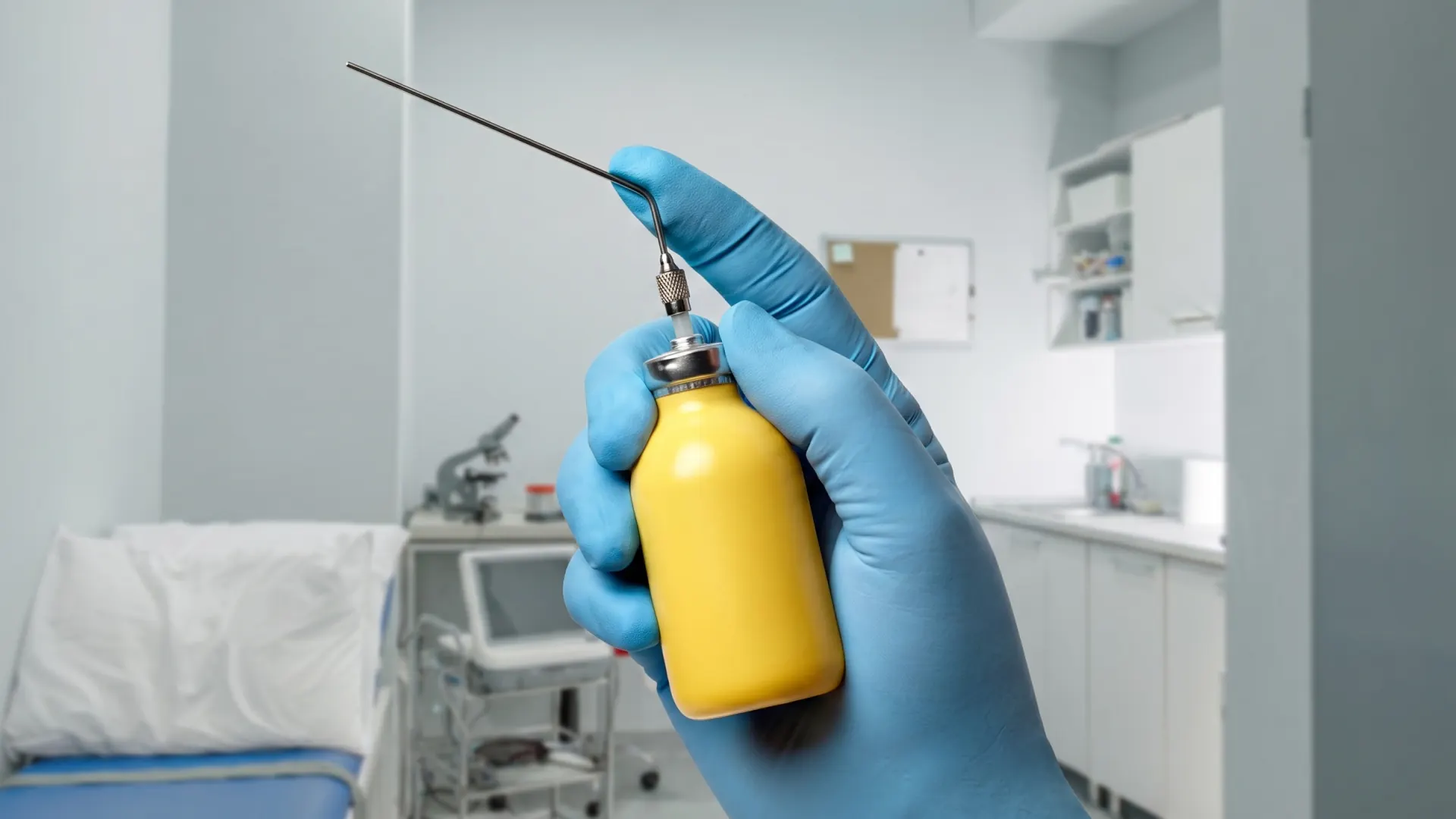
A no-needle vasectomy uses a jet injector instead. It is a small, spring-powered device that presses gently against the skin and fires an extremely fine, high-pressure stream of local anaesthetic straight through it. The stream is finer than any needle, and it delivers the anaesthetic in a fraction of a second. Nothing pierces the skin in the way an injection does. The anaesthetic is pushed through it and spreads around the vas deferens, the tube that the vasectomy will seal.
One point worth clearing up early, because it confuses a lot of men: no-needle and no-scalpel are not the same thing, and many no-scalpel vasectomies still use a needle for the anaesthetic. At Gentle Procedures, the pressure-spray anaesthetic is part of the Pollock Technique, a standardised protocol that combines the no-needle anaesthetic with the no-scalpel opening, so nothing sharp is used at any stage. Our standard no-scalpel vasectomy uses the same tiny opening but delivers the anaesthetic with a very fine needle.
The clinician usually applies the spray 2 or 3 times on each side. The skin and the tissue around each tube go numb within about a minute, and the numbness is then checked before carrying out the procedure.
What the jet spray feels like, moment by moment
The most common description, by a distance, is the flick of an elastic band snapped lightly against the skin. Some men describe it as a quick, cold spritz with a faint sting behind it, and men who have had it at our clinic often call it a brief tap. Either way, it lasts well under a second. There is no needle-style pushing feeling, no slow burn as fluid goes in, and nothing to watch travelling towards you.
Within 30 to 60 seconds, the area feels warm and then simply absent, the same fat-lipped numbness you know from a dental anaesthetic, in a different postcode. From that point on, the nerves that would carry sharp pain are switched off. A published series of the jet technique reports that most men rate the anaesthetic stage at the very low end of a standard 10-point pain scale, and men who have experienced both methods generally describe the spray as more comfortable than the needle.
Two honest caveats. A minority of men feel a brief sting rather than a flick, particularly on the second or third application, and everyone’s skin sensitivity differs. And the jet spray numbs the procedure. It does not numb nerves elsewhere, which is why you may still notice the odd dull, deep sensation later on. That sensation is the subject of the next two sections.
How does that compare with the needle most clinics still use?
It is worth being fair to the conventional method: a needle anaesthetic for vasectomy is quick and effective, and clinicians who use it do so with a very fine needle. Men who have had it typically describe a scratch and a short stinging or pressure feeling as the anaesthetic goes in, lasting a few seconds on each side. Once it takes effect, the rest of the procedure feels the same as it would with the jet spray.
The differences are the ones that matter to an anxious patient. There is no needle to see or anticipate. The delivery takes a fraction of a second rather than a slow push. And because the anaesthetic spreads through the tissue as a fine mist rather than a single deposit, some surgeons find they need less of it.
Scared of needles? This technique was designed for you
Needle fear is not a niche problem. Research suggests that as many as 1 in 4 adults has a significant fear of needles, and a proportion of those avoid medical care because of it. In vasectomy clinics, it is one of the most common reasons men give for having delayed the procedure for years, often while their partner carried the contraceptive burden in the meantime.
If that is you, two things are worth knowing. The first is that the no-needle technique removes the specific trigger. There is no syringe on the tray, nothing is drawn up in front of you, and with the Pollock Technique, nothing sharp is used at any stage. The second is that you do not need to hide the fear. Tell our team when you book your vasectomy appointment. We will talk you through each step before it happens, or not narrating at all if you would rather chat about the football, and pausing whenever you ask. At our clinic, appointments are deliberately generous with time, so there is room to settle before anything happens.
Sedation is very rarely needed for a vasectomy, and most men are surprised to find they do not want it once the first minute is behind them. If your anxiety is severe, raise it at the consultation.
The whole appointment, stage by stage
Knowing the sequence removes most of the fear. Here is the typical shape of a no-needle, no-scalpel vasectomy appointment, and what each stage genuinely feels like. The procedure itself takes around 10 minutes. The appointment around it should never feel rushed, and at Gentle Procedures, it is deliberately not: there is time to ask final questions and settle before anything begins.
Arriving and getting ready
You will be asked to shave the front of the scrotum a day or so beforehand and to bring snug, supportive underwear. On the day, there are consent checks, a chance to ask final questions, and then you lie back on a couch. The area is cleaned with antiseptic, which feels cold, and drapes are placed. Nothing about this stage hurts. For most men, it is the peak of the nerves rather than the peak of any sensation.
The anaesthetic: the click and the flick
The surgeon first locates each vas deferens by touch, which feels like light pressure and a little rolling of the skin. Then comes the jet spray described above – a click, an elastic-band flick, repeated 2 or 3 times per side. Men who rate each stage afterwards typically put this one at around 2 out of 10 for a few seconds, then fall to 0 as the numbness sets in. The surgeon tests the area before going further, and you should speak up if anything still feels sharp.
During the procedure: pressure and tugging, not pain
With the area numb, the surgeon makes one tiny opening and lifts each tube to seal it. What you feel is odd rather than painful – pressure, movement, and a pulling or tugging sensation, a bit like a gentle drawing on a cord deep in the groin. Some men feel a brief, dull ache in the lower abdomen when the tube is lifted, similar to the sensation of a light knock, and it settles as soon as the tube is released. Sharp pain is not part of the deal. If you feel any, say so immediately. Topping up the anaesthetic takes seconds, and the surgeon would always rather pause than have you grit your teeth.
Immediately afterwards
A small dressing goes on, you get dressed, and you walk out. While the anaesthetic is still working, most men feel almost nothing beyond a vague awareness that something has happened. This window lasts an hour or two, and it is the right time to get home, get horizontal, and get an ice pack organised before the numbness fades into a dull ache.
The no-scalpel part: why the opening is smaller and kinder
No-needle refers to the anaesthetic. No-scalpel refers to how the surgeon reaches the tubes, and it matters just as much for comfort afterwards.
Instead of an incision, the surgeon uses a fine, pointed instrument to make a single small opening in the numbed skin, then gently stretches it just wide enough to lift each vas deferens through. The opening is a few millimetres across, usually needs no stitches, and typically seals itself within days. Each tube is divided and closed, and a thin layer of natural tissue is drawn between the two ends, a step called fascial interposition, because the evidence shows it makes the vasectomy more reliable.
At Gentle Procedures, this is done with a dissolving suture, so no metal clips or other foreign bodies are left behind. Our technique is also double open-ended: the testicle-side end of each tube is left unsealed, which allows sperm to be reabsorbed naturally and reduces the pressure build-up that can cause aching in early recovery. Your surgeon will explain the approach at your consultation, including why the evidence supports it.
The practical result of the smaller opening is less bruising, less swelling, and a quicker return to normal than the traditional incision method it replaced.
What the published evidence says about pain
Reassurance is easy to write, so it is fair to ask what the research shows. Two findings are worth knowing.
Regarding the surgical technique, a Cochrane systematic review comparing the no-scalpel approach with the traditional incision found that the no-scalpel method caused less bleeding, bruising, haematoma, infection, and pain, both during and after the procedure, with a faster return to normal activity. That is why the no-scalpel method has become the standard among dedicated vasectomy providers.
On the anaesthetic, the no-needle jet technique was popularised in urology in the early 2000s, and the published series that followed reported low average pain scores for the anaesthetic stage, with men who had experienced both methods generally preferring the spray to the needle. No technique can promise an identical experience for every patient, and individual sensitivity varies, but the direction of the evidence is consistent: smaller opening, finer anaesthetic delivery, less discomfort.
Thinking about a no-needle vasectomy?
Gentle Procedures UK offers the Pollock Technique, a no-scalpel and no-needle approach, so nothing sharp is used at any stage. Care is doctor-led, appointments are deliberately unhurried, and there are no waiting lists. Book a consultation and take as much time as you need to ask questions before you decide anything.
After the anaesthetic wears off: the first 48 hours and week one
2 to 3 hours after the procedure, the numbness fades and is replaced by a dull, bruise-like ache. Most men compare it to the day after a minor sports knock: tender, a little swollen, entirely manageable, and worst on the evening of the procedure and the day after. Some bruising of the scrotum is normal and can look more dramatic than it feels, occasionally spreading before it fades over a week or two. A small amount of pinkish discharge from the opening on the first day is also normal.
By day 3, most men describe awareness rather than pain: they know it happened when they stand up quickly, and forget about it in between. By the end of the first week, the majority feel back to normal at rest, with only heavier activity reminding them to take it easy a little longer. Everyone heals at their own pace, and a slower week is not a sign that anything is wrong, but discomfort that is getting worse rather than better after the first couple of days is a reason to call the clinic, not to wait.
Self-care that genuinely reduces the discomfort
The difference between an easy recovery and a sore one usually comes down to four unglamorous habits in the first few days.
Ice, early and often. A wrapped ice pack or a bag of frozen peas over your underwear, 15 to 20 minutes at a time with breaks in between, several times a day for the first 2 days. Never place ice directly on the skin. Starting while the anaesthetic is still working, before the ache arrives, makes a noticeable difference.
Support, day and night. Snug briefs or dedicated supportive underwear, worn continuously for about the first week, including in bed. Support reduces the pulling sensation that loose boxers allow, and it is the single tip men most often say they wish they had taken seriously.
The right pain relief. Paracetamol is usually the first choice and is enough for most men. Some clinics advise avoiding anti-inflammatories such as ibuprofen for the first day or so because of a small added bleeding risk, so follow the specific advice you are given. Very few men need anything stronger.
Genuine rest for 24 to 48 hours. Feet up, minimal stairs and certainly no lifting. The men who struggle are almost always the ones who felt fine on day 1, did too much, and paid for it on day 2. Feeling fine early is mostly the anaesthetic still working. Treat the first two days as recovery, whether you think you need it or not.
Getting back to normal: work, driving, exercise and sex
Timelines vary between clinics and between men, so treat these as the typical pattern and follow your own clinic’s aftercare sheet where it differs.
- Desk work: most men return within 1-2 days. Many book a Thursday or Friday procedure and are back at their desk on Monday.
- Driving: usually fine within 1 to 2 days, once you are comfortable enough to sit normally and perform an emergency stop without hesitating. Most men are driven home or take it very easy on the drive back the same day.
- Physical work and heavy lifting: allow about a week before returning to manual work, and build back up rather than starting with the heaviest task.
- Exercise: light walking straight away is fine and helpful. Gym work, running and cycling usually restart at about a week. Contact sports and anything with impact to the area deserves closer to 2 weeks and a supportive base layer.
- Sex and ejaculation: Most clinics advise waiting about a week. The first few ejaculations may feel mildly achy and can contain a little old blood, which looks alarming and means very little. One thing matters more than the rest: you are not yet sterile. See the semen test section below.
When pain is not normal
Complications after a no-scalpel vasectomy are uncommon, but they are easier to treat early, and knowing the difference between normal soreness and a problem is part of a calm recovery. Contact the clinic promptly if you notice any of the following:
- Pain or swelling that is getting worse after the first 2 to 3 days rather than better
- A firm, rapidly enlarging swelling in the scrotum, which can be a sign of bleeding inside (a haematoma)
- Spreading redness, warmth, or discharge from the opening, which can be signs of infection
- A fever or feeling generally unwell
- Severe pain at any point
None of these means something has gone irreversibly wrong. Haematomas and infections affect a small percentage of men and are treatable, particularly when caught early. If you are ever unsure whether what you are feeling is normal, a 2-minute phone call beats 3 days of quiet worrying. At Gentle Procedures UK, each patient leaves with a direct out-of-hours number for our clinical team, so that call is available in the middle of the night as well as during clinic hours.
Sex, testosterone and ejaculation: what changes and what does not
This is where the myths live, so here are the facts in one place.
A vasectomy does not affect the testicles’ hormone production. Testosterone levels, sex drive, erections and orgasm are unchanged. The procedure seals the two tubes that carry sperm. It does not alter the nerves or blood supply responsible for sexual function.
Ejaculation looks and feels the same afterwards, because sperm make up only a small fraction of semen volume. The fluid itself is produced further along and is unaffected. Your body continues making sperm, which are simply reabsorbed, a process the body handles routinely and harmlessly. Some men report their sex life improves once the possibility of pregnancy is off the table, though that is a matter of circumstance rather than physiology.
It works, but not immediately: the semen test
A vasectomy is not effective on the day. Sperm remain downstream of the sealed tubes for weeks afterwards, which is why every reputable clinic asks you to keep using contraception until a semen test confirms clearance. The test is usually taken around 12 to 16 weeks after the procedure, following your clinic’s protocol, and involves producing a sample that a laboratory checks for sperm. At Gentle Procedures, the semen test is part of the all-inclusive fee, so there is no separate charge and no reason to skip it.
Once a clear result is confirmed, vasectomy is one of the most reliable contraceptives there is: more than 99% effective. Late failure, where the tube ends rejoin after a clear test, is rare, in the region of 1 in 2,000. The step men most often get wrong is not the procedure but the patience: stopping other contraception before the clear result is the main cause of post-vasectomy pregnancies. Do the test, wait for the letter, then celebrate.
It is also worth deciding as though the procedure were permanent. Reversal exists but is a bigger operation, is not always successful, and is rarely funded by the NHS. If you are not sure you are done having children, that is a conversation for the consultation, not a reason to press ahead.
Having a no-needle vasectomy in the UK: NHS or private
Vasectomy is available on the NHS, but access is uneven. Funding decisions sit with local integrated care boards, so in some areas referral is straightforward, while in others it is restricted or involves a long wait. Where the NHS does provide a vasectomy, it is generally the conventional needle-anaesthetic technique. The no-needle jet-spray method is mostly offered by private and specialist clinics in the UK. If the anaesthetic is the part holding you back, that difference is worth factoring in, alongside the waiting time. We have set out the trade-offs in more detail in our comparison of NHS and private vasectomy.
Privately, a conventional vasectomy in the UK typically costs around £700 – £750, depending on the clinic and what the fee includes. At Gentle Procedures, the standard no-scalpel vasectomy is £749 and the Pollock Technique, with the no-needle anaesthetic, is £1,450. Both fees are all-inclusive: consultation, the procedure, aftercare, out-of-hours support and the post-vasectomy semen test. A consultation on its own is £195, deducted in full from the procedure fee if you go ahead. When comparing prices anywhere, check exactly what is included, because a lower headline price that excludes the semen test is not a lower price. Fees can change, and the clinic will always confirm the exact price with you before you commit to anything.
Choosing a clinic: what to ask before you book
The experience described in this article assumes a surgeon who performs vasectomies frequently and a clinic set up for them. A short set of questions separates that from the alternative.
- Which anaesthetic technique do you use, and is the no-needle jet spray available?
- Do you use the no-scalpel method, and roughly how many vasectomies does the surgeon perform each year?
- Do you use fascial interposition, and is your technique open-ended or closed? Why?
- What exactly does the fee include: consultation, procedure, aftercare and the semen test?
- Is the clinic registered with the Care Quality Commission (CQC), and who do I contact if I have a concern during recovery?
A good clinic answers all five without hesitation. For transparency, here is how we answer them. Gentle Procedures UK is a CQC-registered, doctor-led men’s health clinic. We offer both the no-needle Pollock Technique and the standard no-scalpel method, use fascial interposition with a double open-ended approach, publish all-inclusive fees, and give every patient a direct out-of-hours contact for the clinical team. Our flagship clinic is at Birmingham Business Park in Solihull, with further locations in Brentwood in Essex and across the West Midlands. Ask us the volume question at your consultation, and you will get a straight answer.
This article is general information rather than personal medical advice. The right place to weigh your own history, anatomy and circumstances is a consultation with a qualified clinician, and any reputable provider will offer that conversation before asking you to commit.
Frequently asked questions
Does the no-needle anaesthetic hurt?
Briefly and mildly. The jet spray makes a click and delivers the anaesthetic through the skin in a fraction of a second. Most men compare the feeling to the flick of an elastic band or a brief tap. The area is numb within about a minute, and published series reports that most men rate the anaesthetic stage at the low end of a 10-point pain scale.
How painful is a vasectomy overall, honestly?
With local anaesthetic working, you should feel pressure and a tugging or pulling sensation rather than pain, occasionally with a brief dull ache in the lower abdomen as each tube is lifted. Afterwards, expect a bruise-like ache for 2 to 3 days, which can be managed with paracetamol, ice, and supportive underwear. Sharp pain at any stage is a reason to tell the surgeon or contact the clinic.
What does the jet injector feel and sound like?
It makes a short, sharp click as it fires, similar to a stapler. The sensation is a split-second flick against the skin, sometimes described as a cold spritz with a faint sting. It is applied 2 or 3 times on each side, and numbness follows within 30 to 60 seconds.
Is a no-needle vasectomy available on the NHS?
Rarely. NHS vasectomy access varies by local area and usually uses the conventional needle anaesthetic. The no-needle jet-spray technique is mostly offered by private and specialist vasectomy clinics in the UK, including as part of the Pollock Technique at Gentle Procedures.
Is no-scalpel the same as no-needle?
No. No-scalpel refers to how the surgeon reaches the tubes through one tiny, stretched opening instead of an incision. No-needle refers to how the anaesthetic is given, by jet spray instead of injection. Many no-scalpel vasectomies still use a needle for the anaesthetic. At Gentle Procedures, the Pollock Technique combines both, no scalpel and no needle, while our standard no-scalpel option uses a very fine needle for the anaesthetic. It is worth asking any clinic what they offer.
How long does pain last after a vasectomy?
The typical pattern is a dull ache for 2 to 3 days, easing to occasional awareness by the end of the first week. Mild twinges with exercise or ejaculation can persist a little longer and usually fade. Pain that worsens after the first couple of days, or severe pain at any time, should be assessed promptly.
Can I drive myself home after a no-needle vasectomy?
The procedure uses local anaesthetic only, so many men do drive home, ideally a short drive. If you feel sore, light-headed or anxious, arrange for someone to collect you. Resume normal driving once you can sit comfortably and perform an emergency stop without hesitation, usually within 1 to 2 days.
When can I go back to work?
Most men with desk jobs return within 1 to 2 days. A Thursday or Friday appointment often means back to work on Monday. Physical and manual jobs need about a week, returning to heavy lifting gradually.
What if I have a serious fear of needles?
Tell the clinic when you book. The no-needle technique removes the injection entirely, which resolves the specific trigger for most needle-phobic men, and an experienced vasectomy surgeon will adapt the appointment to your anxiety. If your fear is severe, discuss options at the consultation before the day.
How much does a private no-needle vasectomy cost in the UK?
Conventional private vasectomy in the UK typically costs between about £400 and £700, depending on the clinic and what the fee includes. At Gentle Procedures, the all-inclusive fee is £749 for the standard no-scalpel vasectomy and £1,450 for the no-needle Pollock Technique, covering the consultation, the procedure, aftercare and the post-vasectomy semen test. Always confirm the exact fee with the clinic before booking, as prices vary.
Ready to talk it through?
If the anaesthetic has been the thing holding you back, the no-needle option exists for exactly that reason. Our team can talk you through the Pollock Technique and the standard no-scalpel vasectomy, what each fee includes, and which is right for you, with no pressure to decide on the call. Get in touch with our team to ask a question or arrange a consultation at a time that suits you.