A reassuring UK guide to circumcision healing, week by week, for babies and adults. Learn what is normal, the warning signs, and when to call us.


If you are watching a circumcision heal, whether it is your own or your baby’s, it is natural to wonder what is normal. This guide walks you through circumcision healing step by step, so you know what to expect and when to ask for help. We cover newborns, children and adults, and we explain the warning signs that mean you should contact a clinician.
Healing usually follows a predictable path. Some swelling, bruising and colour change are part of that path, not a sign that something has gone wrong. The aim here is to help you tell the difference between ordinary healing and the small number of signs that need a professional review.
We have written this as a reassurance-first guide because the early days can feel uncertain. By the end, you should have a clear picture of the usual stages, the signs that everything is on track, and the moments when it is sensible to pick up the phone.
How long does a circumcision take to heal?
For most adults, it takes around 4 to 6 weeks for the penis to heal fully after a circumcision, although it can sometimes take a little longer1. Babies and young children often heal faster, with the area usually looking much better within 7 to 10 days and settling over a few weeks2.
Healing is not one single moment. The surface tends to look better within the first one to two weeks, while deeper healing and the final cosmetic result continue over the following weeks. The table below gives a general guide.
| Age group | Early healing (looks better) | Full healing (typical) |
|---|---|---|
| Newborns and babies | 7 to 10 days | Around 2 to 4 weeks |
| Older children and teens | 7 to 14 days | Around 3 to 6 weeks |
| Adults | 10 to 14 days | Around 4 to 6 weeks |
These are typical ranges, not fixed rules. Your own timeline may be a little shorter or longer, and that can still be perfectly normal. Age, the method used, general health and how closely aftercare is followed can all gently nudge the timeline in one direction or another.
What does normal circumcision healing look like?
In the first days and weeks, the area often looks worse before it looks better. This is expected. Normal circumcision healing can include swelling, bruising, colour changes, a yellow or white film, and a little oozing. Here is what each of these means.
Swelling, bruising and colour changes
Swelling and bruising are common for the first 1 to 2 weeks1. The skin may look red, pink, purple or darker, and the head of the penis can appear shiny or swollen. On black or brown skin, redness can be harder to see, so look for warmth and changes in how the area feels as well1.
The tip is often very sensitive at first. This usually eases over the following weeks as healing settles.
The yellow film or white coating
A yellow or whitish film often appears over the healing area after a few days. This is granulation tissue, a normal part of wound healing, and it is not the same as pus3. It can look a little alarming, but it usually means the body is doing its job. Do not try to wipe or scrub it away.
A little bleeding or oozing
Minor bleeding or oozing can happen for the first week or two, especially after a nappy change or when the area is gently moved1. A few small spots of blood are usually nothing to worry about. Heavy bleeding that does not stop is different, and we cover that in the warning signs below.
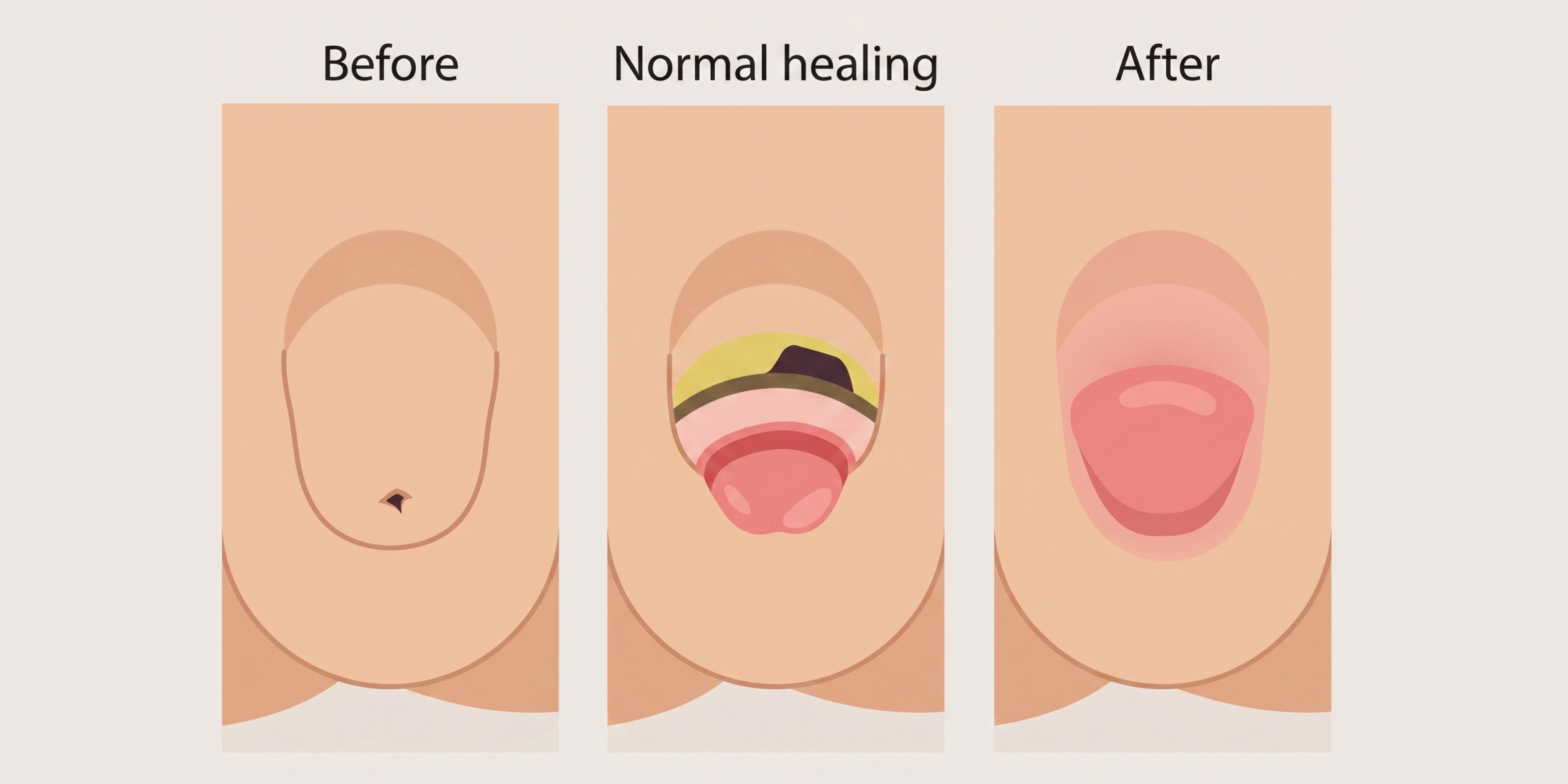
Circumcision healing stages, week by week
Knowing the usual circumcision healing stages can take a lot of the worry out of the first few weeks. The pattern below is a general guide for the typical healing process.
| Stage | What you may notice |
|---|---|
| Days 1 to 3 | Swelling, bruising and tenderness are at their peak. Some oozing or spotting can occur. |
| Days 4 to 7 | A yellow or white film often forms. Swelling starts to settle and discomfort eases. |
| Week 2 | Bruising fades. The area looks less raw, though it may still be sensitive. |
| Weeks 3 to 6 | The surface looks much more settled. Deeper healing and the final appearance continue to develop. |
Babies and newborns
A baby’s circumcision often looks better within 7 to 10 days, with fuller healing over the following weeks2. It is very common for the area to look swollen and to develop a yellowish film in the first few days. This is normal and tends to settle on its own3. You can find step-by-step care advice in our newborn after circumcision guide.
Older children and teens
Children and teenagers usually heal within about 2 to 6 weeks. Keeping the area clean and avoiding rough activity, sport, and cycling for the first couple of weeks helps healing along1. Our patient guides include tailored aftercare for boys and teens.
Adults
For adults, the male circumcision healing time is usually around 4 to 6 weeks for full healing1. You may feel tightness or discomfort during an erection in the early weeks, which usually eases as the area settles1. It is best to avoid sex or masturbation for at least 4 weeks, or until the wound has fully healed1. You can read more on our adult circumcision page.
Looking after the area while it heals
Gentle, consistent care gives healing the best chance and helps you feel more in control. None of this is complicated, and your clinician will give you advice tailored to your or your child’s procedure.
A few simple habits tend to help in the first couple of weeks1:
- Keep the area clean by washing gently, then pat it dry or let it air dry.
- Wear loose-fitting clothing and underwear to avoid rubbing.
- Use painkillers such as paracetamol or ibuprofen for adults and older children if needed, following the instructions on the packet.
- Avoid swimming, cycling, sport and heavy lifting for at least 2 weeks.
- For babies, change nappies often and keep the area clean and dry.
There are also a few things to avoid. Do not give aspirin to children under 161. Do not soak in a long bath in the early days, and do not pick at any film or scabbing, as this can disturb healing. Adults should avoid sex or masturbation for at least 4 weeks, or until the wound has fully healed1.
If you are ever unsure whether something you are doing is helping or not, ask. A quick question now can save a lot of worry later. Our newborn circumcision page also explains the care included with every procedure.
Most importantly, try not to compare your healing too closely with photos you find online. Lighting, age, method and timing all change how things look, and a wide range of appearances can be perfectly normal.
- Circumcision
Talk to us if you are unsure
Healing can be a worrying time, but you do not have to work it out alone. If you would like a clinician to take a look or answer your questions, our Birmingham team is here to help, with follow-up care included as standard.
Contact Gentle Procedures UK to arrange a review or to ask about circumcision care for you or your child.
How the Pollock Technique affects healing
At Gentle Procedures UK, our doctors use the Pollock Technique™, a method designed to make recovery as gentle as possible. One feature that can affect how healing looks is that the technique often avoids the need for traditional sutures, using a tissue adhesive instead. This can mean fewer stitches to worry about as the area heals.
Different methods can heal and look slightly different along the way, so it helps to know which approach was used. If you would like to understand the method in more detail, see our page on what makes the Pollock Technique different.
Whatever the method, the underlying healing process is similar: swelling and colour changes settle first, then the deeper tissue and final appearance follow over the weeks. Your consultant will explain what to expect for the specific approach used in your or your child’s procedure.

Circumcision healing wrong: signs to watch for
Most people heal without any problems. Still, it helps to know the circumcision healing wrong signs so you can act quickly if needed. Contact a clinician if you notice any of the following1.
See a GP, contact us, or call NHS 111 if:
- There is pus, discharge or a bad smell coming from the wound
- The wound re-opens
- There is new or increasing bruising or bleeding
- The stitches (if used) have not dissolved after 6 weeks
- Your child seems unusually unsettled, is feeding poorly, or you are simply worried
Get urgent help, or call 999 or go to A&E, if:
- There is bleeding that does not stop
- The area is red, hot or increasingly painful, which can be a sign of infection (redness may be harder to see on black or brown skin)
- There is a high temperature, or feeling hot, cold or shivery
- Passing urine becomes very difficult, or it is not possible to pass urine at all
Always call 111 for a child under 5 if you are worried1. If you think the area may be infected, our separate guide on signs of an infected circumcision goes into more detail.
When to contact your clinic
You do not have to wait for a warning sign to get in touch. If something does not look right, or you simply want reassurance, it is always reasonable to ask. An earlier review usually means a smaller, simpler fix if anything does need attention.
As a Birmingham clinic that includes follow-up care with every procedure, we are happy to take a look and put your mind at rest. A quick check can often turn worry into reassurance in a few minutes.
If you are between appointments and unsure, contact us, speak to your GP, or call NHS 111. For anything urgent, use 999 or A&E guidance in the section above.
Frequently asked questions
How do I know if my circumcision is healing properly?
What does a fully healed circumcision look like?
Once healed, the area no longer looks swollen or bruised, any film has cleared, and the skin looks settled. For adults, full healing typically takes around 4 to 6 weeks1. The final appearance can keep refining for a little while after that.
What helps a circumcision heal faster?
Gentle care helps most: keep the area clean, pat it dry or let it air dry, wear loose clothing, and avoid sport, cycling and heavy lifting for the first couple of weeks1. There is no product that speeds up healing dramatically, so be cautious about claims that suggest otherwise.
How long should I apply petroleum jelly after a circumcision?
A thin layer of petroleum jelly can help stop the area from sticking to clothing or nappies in the early days. Follow the specific aftercare advice given by your clinician, as guidance can vary by age and method. Your consultant will tell you how long to continue.
Is it normal for a baby’s circumcision to look worse before it looks better?
Can a circumcision heal without stitches?
Yes. Some methods, including the approach we use, can avoid traditional stitches and use a tissue adhesive instead. The area still heals through the same natural stages. Your consultant will explain what was used and what to expect.
References
- NHS. Circumcision (healing time, normal swelling and bruising, aftercare and warning signs). Last reviewed March 2026.
- NHS Greater Glasgow and Clyde, Royal Hospital for Children. Information about Infant (Newborn) Plastibell Circumcision (healing over 7 to 10 days). March 2023.
- Hull University Teaching Hospitals NHS Trust. Circumcision: Advice for Parents (oozing and the film or scabs as a normal part of healing). Reviewed 2025.